
In New Port Richey, a house can flood with no named storm anywhere near the Gulf. The city says many areas flood with only a high tide and a west wind. For owners near the river or the canals, that makes tidal water a regular risk, not a rare one.
Key takeaways
- The city says many areas flood with only a high tide and a west wind, so flooding does not need a hurricane.
- The Gulf of Mexico and the Cotee River create risk of storm surge, flash flooding and prolonged inundation.
- About 44 percent of the city lies in a Special Flood Hazard Area, and the city says high risk zones have a one percent chance of flooding in any year.
- Tidal water carries salt, silt and street debris, so it is extracted fast and floors and walls are cleaned before drying.
- Repeat flooding makes careful drying and a written moisture log more important.
How a calm day can still flood a house
The city sits on the Pithlachascotee River, also called the Cotee River, in the Tampa Bay area. The city says the Gulf of Mexico and the river create risk of storm surge, flash flooding and prolonged inundation.
It also says many areas flood with only a high tide and a west wind. No rain or storm is needed, only the water level and the wind direction.
Tides follow a calendar, so high tide days can be tracked in advance, while the wind direction is harder to predict. Owners near the river can watch both.
- A high tide pushes water up the river and into the canals near it.
- A west wind can hold Gulf water against the shore so it drains slowly.
- Rain on top of a high tide adds water that has nowhere to go.
Where tidal water reaches first
Two sources describe the pattern. One is the National Weather Service, which ties flooding to the reading on the New Port Richey tide gauge.
The other is the city's own drainage planning.
What the National Weather Service lists
As the tide gauge rises, the National Weather Service lists the Sims Park boat ramp as one of the first places to flood, with canals running high. At higher levels, water begins to reach a few homes west of U.S. 19 and a mobile home park south of Louisiana Avenue and Paradise Drive.
At still higher levels, numerous homes near and north of Green Key Road and west of U.S. 19 flood, and Trouble Creek Road and Straub Memorial Drive take water. At the highest listed levels, many homes west of U.S. 19 between Florance Terrace and Ridge Road flood, with water on U.S. 19 and on Main Street near the Pithlachascotee Bridge.
Areas the city has flagged
The city's 2013 Stormwater Master Drainage Plan update flagged the Beach Street and High Street area for continual street flooding and repetitive flooding of homes during storm events. It flagged the Rio Drive area, near Wyoming and Lafayette, and the Carlton Road, Dartmouth Road and Berkley Avenue area for repetitive flooding of homes.
The city describes Town and Country Villas, around Leisure Lane and Van Doren Avenue, as historically flood prone.
What tidal water does inside a home
Tidal water is not rainwater. It carries salt, silt and whatever the street and the canal were holding, so a restoration team treats it as contaminated.
Salt matters most. It keeps pulling moisture from the air, so drywall and wood can look dry while they still read wet.
Garages and ground floor rooms take tidal water first, and it settles under cabinets and into the bottoms of walls, where it is easy to miss.
- Carpet, pad and swollen lower cabinets come out first.
- Drywall and insulation are cut above the water mark when they wicked tidal water.
- Block walls and the slab are washed to remove salt before drying starts.
- Baseboards and trim are pulled so the wall bottoms can be cleaned.
First steps when water is at the door
A short checklist keeps a tidal flood from becoming a longer repair.
- Turn off power to flooded rooms at the panel if the panel is dry and safe to reach.
- Do not walk through standing water that may touch outlets or cords.
- Photograph the water level on walls and furniture before anything is moved.
- Lift small items, rugs and electronics to a dry surface.
- Call for extraction while the water is still standing, because pulling it early limits how far it wicks.
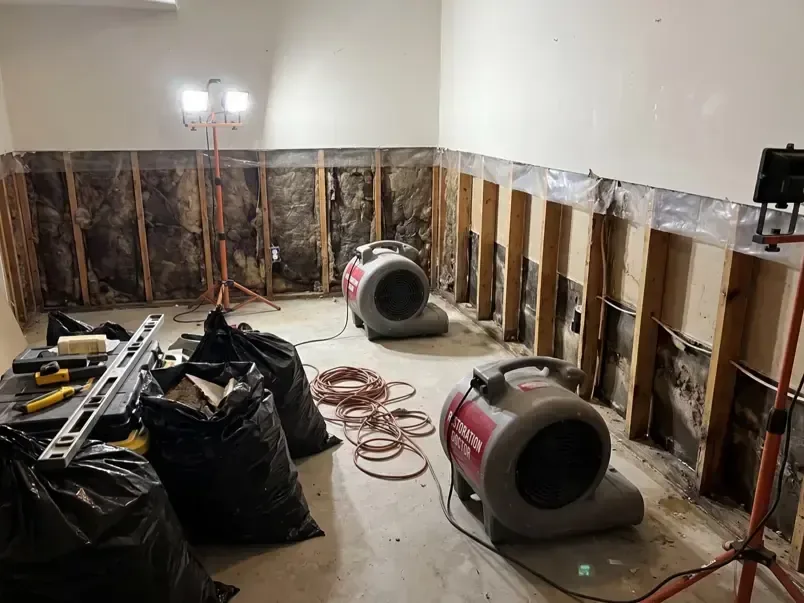
Extraction and drying
Water extraction comes first. Truck mounted units pull water from floors and from under cabinets, and silt is removed from corners and wall bottoms.
After cleaning, structural drying brings the slab, the block and the framing back to a dry reference. LGR dehumidifiers and air movers run with the house closed, and readings are logged every day.
- Typical drying runs 5 to 10 days after the tear out.
- Surfaces that look dry but still read damp are washed again.
- Rebuilding waits until readings match the dry reference.
Why repeat flooding calls for careful drying
The city says properties in its high risk flood zones have a one percent chance of flooding in any year and a 26 percent chance of flooding over a 30 year mortgage. A home that floods once can flood again.
Moisture left in a slab or in framing adds up from one event to the next. A written moisture log shows that each event ended with a dry structure.
- Keep the final readings and the photos in one folder.
- Ask for baseboards and trim to be reinstalled only after drying ends.
- Learn which parts of the house hold moisture longest, such as wall bottoms and closets.
When the tide comes with a storm
A tide that comes with a hurricane or a heavy storm is a larger event. Storm surge flood cleanup follows the same Category 3 rules, with more removal and more drying.
The city lists Hurricane Hermine, Hurricane Irma and Hurricane Idalia among the storms that have affected it, and Helene and Milton followed in September and October 2024.
When wind and rain come through the building as well, hurricane water damage work is added to the flood work, and each is dried to its own readings.
Questions
Can a house flood with no rain or storm?
Yes. The city says many areas flood with only a high tide and a west wind, so low homes near the river and the canals can take water on a calm day.
Is tidal water treated as contaminated?
Yes. It carries salt, silt and street runoff, so porous materials it touched are removed and hard surfaces are cleaned and treated.
Why does salt matter in drying?
Salt attracts moisture from the air, so walls and wood can feel dry and still read damp. Washing comes before the fans.
What is a Special Flood Hazard Area?
It is a zone on the flood maps with a higher chance of flooding. The city says about 44 percent of New Port Richey lies in one.
How long does a tidal flood take to dry?
Typical drying runs 5 to 10 days after the tear out, and daily readings decide when it ends.
Why does a west wind matter?
The city names a west wind along with a high tide as enough to flood many areas. A west wind can hold Gulf water against the shore, so it drains more slowly.