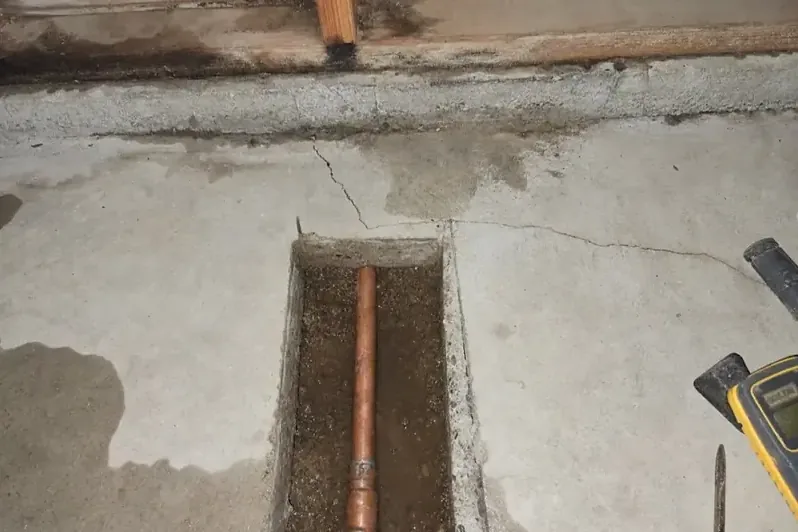
A pinhole in a copper pipe under a concrete floor can leak for weeks before anything shows. In a block home on a slab, the water has nowhere to go but sideways and up. The signs are quiet, and catching them early keeps the damage small.
Key takeaways
- Copper supply pipe in or under the slab can pinhole in block homes built in the 1970s to 1990s, and the leak stays hidden under tile, plank flooring or carpet.
- The quiet signs are a warm spot on the floor, a water bill that climbs with no change in use and the sound of running water with every fixture off.
- A meter test with every fixture off shows whether water is moving before any flooring is lifted.
- Flooring comes up only where moisture meters and thermal imaging show water underneath, and the slab is dried to readings, not to a set number of days.
- Humid Gulf air slows slab drying, so a closed house with the AC running and dehumidifiers works better than open windows.
Why older Hudson homes get slab leaks
Hudson, an unincorporated community in Pasco County, is full of single story concrete block homes built between the 1970s and the 1990s. Most sit on a slab, with no basement and no crawl space.
In many of them the copper supply pipe runs in or under the concrete. Over decades the copper wears where it rubs against the slab and where it carries hot water.
Eventually a pinhole opens. The water pushes up through the floor or sideways into the bottoms of the walls, and nothing on the surface looks wrong at first.
Hidden leaks of this kind are the core of slab leak water damage work, and they behave differently from a split pipe in an open wall.
Quiet signs of a slab leak
A slab leak rarely begins as a puddle. Water spreads under the flooring and wicks into the drywall, so the first signs are indirect.
Any one of the signs below deserves a meter check. Two or three together make a slab leak likely.
The water bill is the earliest clue for many owners, because a hidden leak runs around the clock. Comparing this month to the same month last year takes a minute and tells a lot.
- A warm spot on tile or plank flooring, often a sign of a hot water pipe leaking below.
- A water bill that climbs with no change in how the household uses water.
- The sound of running or hissing water when every fixture is off.
- Wet or stained baseboards, swollen trim and loose tiles with no visible source.
- Carpet that stays damp along one wall, or a musty smell in one room.
Check the meter before lifting any flooring
A quick test separates a leaking pipe from other causes. It needs no tools, only a few minutes of patience.
A simple meter test
Turn off every fixture and appliance that uses water, including the ice maker and the sprinkler system.
Find the water meter and look at the small leak indicator, usually a dial or a triangle. If it keeps turning, water is escaping somewhere between the meter and the fixtures.
- Turn off every tap, appliance and irrigation zone.
- Read the indicator on the meter.
- Check again after a short wait to see whether it moved.
What the result tells you
A moving indicator points to a leak in the slab, in a wall, in the attic or outdoors. A still indicator means the stain more likely comes from a drain, the air conditioner or the roof.
A split pipe above the floor, in a wall or in the attic, is handled as burst pipe water damage rather than a slab problem.
How the leak is found and the wet area is mapped
Finding the pipe
A plumber locates the leak with listening gear and pressure tests. The repair either opens the slab or reroutes the pipe through the walls or the attic.
The restoration team does not hunt for the pipe. Its job is to find where the water went.
Mapping the water
The team scans the slab, the flooring and the walls with moisture meters and a thermal camera. Thermal imaging shows temperature differences under the flooring, which outlines the wet zone without tearing anything up.
- Flooring is lifted only where readings show water underneath.
- Wet carpet pad, plank flooring and baseboards come out where moisture is trapped.
- Tile that tests dry underneath can often stay in place.

Drying a wet slab in humid air
Concrete dries slowly, and Gulf humidity makes it slower. The crew keeps the house closed with the AC running and sets LGR dehumidifiers and air movers across the slab and along the walls.
The goal is a slab and wall bottoms within 2 to 4 points of a dry reference reading. Readings, not the calendar, decide when structural drying is finished.
A home can feel dry while the concrete and the wall bottoms are not, which is why meters, not touch, make the call.
- Readings are logged each day until the slab and the wall bottoms match the dry reference.
- Typical drying runs 4 to 8 days, and humid weather can stretch it.
- New flooring waits until the slab reads dry, because trapped moisture ruins glue, planks and baseboards.
What to do while waiting for the plumber
Small steps protect the floor and keep the record clear.
- Photograph the stain, the meter indicator and any warm spot on the floor.
- Shut off the main water valve if the meter keeps turning and the leak cannot be isolated.
- Lift rugs and move furniture off the wet area.
- Keep the AC running and leave the windows closed in humid weather.
- Leave the slab alone: drilling or cutting it can hit other pipes and wiring.
Flooring choices after a slab leak
What happens to the floor depends on what it is made of. Each type reacts to trapped moisture differently.
The restoration team lifts only what the readings require, and the plumber and the flooring installer then work from that record.
- Tile set on the slab often stays if the readings under it drop to a dry reference.
- Plank and laminate flooring swell at the seams and are usually replaced where wet.
- Carpet pad holds water and is removed, while the carpet itself can sometimes be dried.
- Baseboards and wall bottoms are pulled when they read wet, then reinstalled after drying.
When water is standing on the floor
A leak that surfaces as standing water changes the order of work. Water extraction comes first, then the hidden moisture is mapped and dried.
Pulling the water early keeps it from wicking higher into drywall and cabinet bases.
Questions
How can I tell a slab leak from a leak in a wall?
A warm patch of floor, a moving meter with every fixture off and damp spots that follow the floor instead of a wall point to the slab. A plumber confirms the location with testing.
Who repairs the leaking pipe?
A plumber finds and fixes the leak, either through the slab or by rerouting the pipe through the walls or the attic. The restoration team dries what the water touched.
Does all the tile have to come up?
Not usually. Flooring is lifted only where moisture readings and thermal imaging show water underneath, and dry tile can often stay.
How long does a wet slab take to dry?
Typical drying runs 4 to 8 days, and readings decide the finish. Humid air can stretch the schedule.
Can a slab leak damage rooms away from where it started?
Yes. Water travels under flooring and wicks up the bottoms of walls, so damage can show in a room well away from the leak.
Why do Hudson homes from the 1970s to the 1990s get slab leaks?
Copper supply pipe in or under the concrete wears over decades, especially where it rubs against the slab or carries hot water.