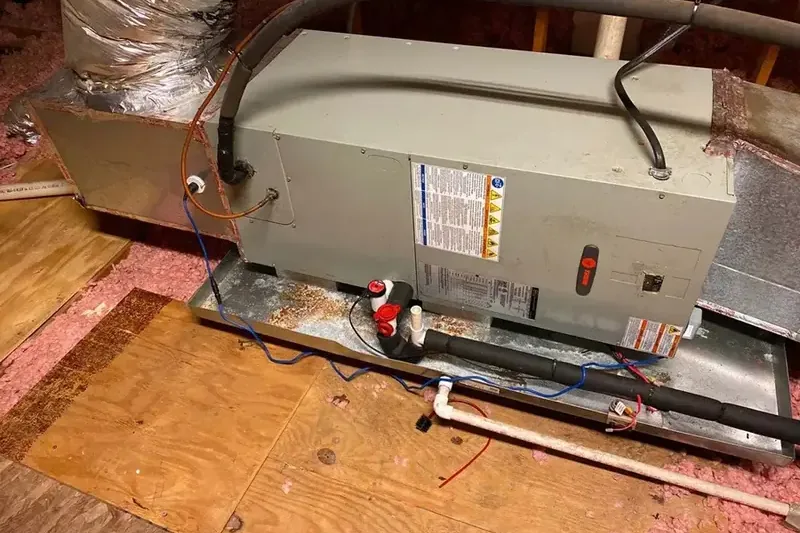
An air conditioner in humid Hudson pulls gallons of water out of the air every day. That water leaves through a small PVC drain, and when the drain clogs it has nowhere to go but into the house. A brown ceiling stain is often the first sign.
Key takeaways
- Every air handler makes condensate, and algae and sludge in the small drain pipe clog it.
- Where the leak shows depends on where the unit sits: attic units stain ceilings, closet units soak hallway floors and garage units wet the slab and the shared wall.
- Condensate counts as Category 2 water, so wet pad comes out and surfaces get an antimicrobial.
- Turn the AC off when water appears, then call an HVAC technician for the drain and a restoration team for the drying.
- A float switch that shuts the system off when the pan fills is the cheapest protection.
Why a clogged condensate drain overflows
Air conditioning runs most of the year on the Gulf coast, and humid outdoor air means a lot of condensate. The water drips into a pan under the coil and drains through a PVC pipe to the outside or to a nearby drain.
Algae and sludge grow inside that small pipe. When it clogs, the pan fills and spills, and the overflow can run for days before anyone notices.
Near daily afternoon thunderstorms in the summer keep the air wet, so the system works hard and the drain never gets a rest.
Where the water goes depending on the air handler
Many slab homes in Hudson keep the air handler in a hallway closet, the garage or the attic. The location decides what gets wet.
Attic units
Water soaks the insulation first, then stains or sags the ceiling below. The stain on the ceiling is usually smaller than the wet area above it.
Wet insulation holds water against the drywall, so the ceiling keeps absorbing even after the AC is off.
Closet units
Water runs under the closet door into hallway flooring and baseboards. It can wick into the walls on both sides.
Laminate and plank flooring swell at the seams, so a small spill can look much worse a day later.
Garage units
Water pools on the slab and wicks into the shared wall with the house. Drywall at the bottom of that wall is the first thing to go soft.
Because the garage floor is bare concrete, the damage hides in the wall, not on the floor.
Why a small drain causes a big leak
An air handler can remove several gallons of water from humid air on a hot day. All of that depends on a pipe about as wide as a finger staying open.
When a clog forms, the only relief is the overflow pan, and the pan is shallow. Once it fills, every minute the system runs adds more water to the ceiling, the closet or the wall.
- A float switch should cut power to the system when the pan fills, but it can fail or be missing.
- A secondary pan or a second drain stub is a backup that many older systems never had.
- A leak that runs only on hot afternoons is easy to dismiss until the stain appears.
Signs before the ceiling sags
A clogged drain usually warns before it floods. The signs are easy to miss when the unit is out of sight.
- A brown or yellow stain on a ceiling that spreads after the AC runs.
- Water in the metal pan under the air handler, or a rusty pan.
- A musty smell in a hallway closet or near the garage door.
- Warped baseboards on one wall of the hallway.
- The AC shutting off by itself, which can mean the float switch tripped.

What to do right away
Fast steps keep a small leak from becoming a ceiling replacement.
- Turn the AC off at the thermostat so the pan stops filling.
- Move furniture and rugs out from under the stain.
- Do not poke a sagging ceiling, because it can hold a lot of water. If it bulges, a restoration team opens it safely.
- Photograph the stain, the pan and the drain pipe.
- Call an HVAC technician to clear the drain and a drying team to check what the water reached.
Ceilings, light fixtures and safety
Water that collects above a ceiling can reach light fixtures and wiring. A fixture that fills with water or a ceiling that drips near a switch is an electrical risk.
If water is near a fixture, turn off that circuit at the panel and keep people out from under it. A restoration team opens the ceiling in a controlled way so the water drains into a bucket, not across the room.
- Never touch a wet fixture or switch.
- Place a bucket under a drip and keep the circuit off.
- Do not use a ladder under a bulging section of ceiling.
How the leak is dried
The tech who does the walkthrough checks the ceiling, the closet walls and the flooring with moisture meters, because condensate spreads farther than the stain shows. The crew pulls wet insulation, opens sagging drywall safely and extracts any water on the floor.
Condensate is Category 2, so wet carpet pad comes out and surfaces get an antimicrobial. Then LGR dehumidifiers and air movers dry the cavity, with the AC back on once an HVAC technician has cleared the drain.
- Ceiling and attic insulation checked above the stain.
- Closet and hallway floors extracted and dried.
- Typical drying runs 3 to 5 days.
Keeping the drain clear
An overflow is rarely a one time event, so the drain needs attention after the cleanup. AC leak water damage is easy to repeat if the cause stays in place.
- Ask the HVAC technician to flush the drain and test the float switch.
- Use the cleaner and the schedule the technician recommends for the drain.
- Check the pan during hot, humid months when the system runs the most.
- Keep the space around the air handler clear so a leak is seen early.
When the stain is not from the AC
A ceiling stain can also come from the roof or a pipe in the attic. Ceiling leak water damage work starts with tracing the source, and a stain that appears after a thunderstorm may point to the roof.
If standing water is on the floor, water extraction comes first so it does not wick into the walls. Afterward, structural drying brings the cavity back to a dry reading.
Questions
Why is my air conditioner leaking water inside?
The most common cause is a clogged condensate drain. Algae and sludge block the small pipe, the pan fills and the water spills into the closet, garage or attic.
Is AC condensate clean water?
No. Condensate counts as Category 2 water because it gathers dirt and growth from the coil and the pan, so wet pad is removed and surfaces are treated.
Can a stained ceiling be dried without cutting it?
Sometimes. If the drywall is firm and readings are low, it can be dried in place. A sagging or bulging ceiling is opened so the water drains and the cavity dries.
Who fixes the air handler?
An HVAC technician clears the drain and checks the float switch. The restoration team dries what the water reached.
How long does drying take after an AC leak?
Typical drying runs 3 to 5 days, depending on how far the water spread and how humid the weather is.
Does a ceiling stain mean the drywall must be replaced?
Not always. Firm drywall with low readings can be dried in place. Soft, sagging or crumbling drywall is cut out, and the cavity is dried before a patch goes up.